Step by step

Alright, today I’m going to be sharing with you a little bit about a section that was very difficult for me to understand. I struggled with multistage experiments. Here’s a few examples of what those types of problems typically look like, as well as my thought process when I’m solving them.

  • There are 60 employees in a certain firm. We know that 36 of these employees are​ male, 12 of these males are​ secretaries, and 24 secretaries are employed by the firm. What is the probability that an employee chosen at random is a​ secretary, given that the person is a male

What I’ve found messes me up in these problems, is understanding exactly what’s happening in the problem. So, let’s start there. What information do we have?

There are 60 employees total.

36 of those are male

12 males are secretaries

There are 24 secretaries total

  • Alright, now don’t let all that information scare you. I’ve found that it’s super helpful to just break it down step by step and checking along the way helps in solving these problems.

Remember that we are looking for the probability that a random male is selected, is a secretary. There is a lot of unnecessary information in this problem that could be confusing.

  • There are 36 male secretaries. Which gives you 36 males to choose from. 12 of those males are secretaries. So:  12/36 is the probability of randomly selecting a male that is a secretary.  This would simplify down to 1/3.

I hope this helps anyone else who also gets things mixed up during multistage experiments.
Fun with candy!

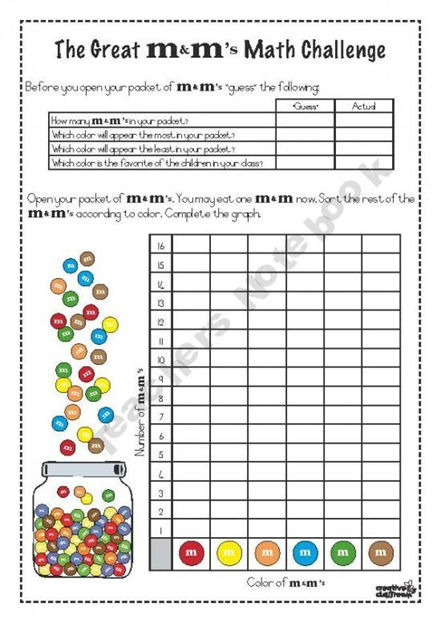
Hey guys! So, I am ALL for making math as fun as possible. Recently in class we did a super fun activity using M&M’s. Not only is this project fun and engaging, but delicious too! We did this through the online course and had to go buy m&ms and submit pictures of our results but this would totally work in a classroom too! It is perfect for teaching probability.

Here’s how it works:

  • Each student would be given one bag of m&m’s.
  • Then, count the total number of m&m’s in their bag
  • Next, students will sort out the colors and count how many of each color there are
  • Record/graph
  • Find the probabilities

We did have an assigned packet that went along with  this. The beauty of an assignment like this though is you can make changes and make it your own. Here’s a few examples of problems that can be solved using this data:

  1. Graphing- especially for younger students this is a great way to teach them how to make a graph using their sorted m&m’s.
  2. Probability (which is mainly what we used it for). Students could find the probability of finding a red m&m in their package. Ex: If there are 25 m&m’s in a package, and 6 of them are red, the probability of picking up a red m&m is 6/25 or 24%.
  3. Making predictions- get their brains thinking and wondering. Students will take an educated guess on a given probability

I’ll attach some images so that you can get a better idea of what I’m talking about.


http://indulgy.com/post/eVGltx1MS1/m-m-math-use-when-teaching-money
M Math estimation, sorting, addition,comparing number, problem solving...

http://snippetsbysarah.blogspot.com/2011/09/m-math.html